
Water Damage Restoration Cost Guide: What Financial District Homeowners Pay in 2026
Most national cost guides will tell you water damage restoration runs $3,000 to $7,000. That number has almost nothing to do with a Financial District co-op or condo. A single-floor water loss in a pre-war building with hardwood floors, plaster walls, and a freight elevator that costs $500 a day starts around $14,000 before a single board gets replaced. Here’s the real breakdown, line by line, for 2026.
If you’re standing in water right now and don’t need the full guide, call Water Damage Restoration in Financial District at (518) 663-6491. A live dispatcher answers, day or night. If you want to understand the numbers before you spend a dollar, keep reading.
What Financial District Water Damage Actually Costs in 2026: The Real Ranges
Forget national averages. In the Financial District, your cost depends on three things: building type, water category, and how fast extraction starts. A converted loft on Water Street with exposed brick and open ductwork prices differently than a glass tower unit on Broad Street with dropped ceilings and engineered flooring. Here’s what we see on actual jobs in the neighborhood:
- Pre-war co-op, single-floor leak (hardwood, plaster, radiators): $14,000-$28,000. Plaster absorbs water differently than drywall. It holds moisture longer, which means more drying days.
- Glass tower condo, supply line break (gypcrete, engineered wood, dropped ceiling): $9,000-$22,000. Gypcrete pours can wick water ten feet from the source, and engineered flooring almost always delaminates.
- Converted loft, roof or window leak (concrete, brick, open ceiling, sealed floors): $6,000-$16,000. Concrete dries faster than wood framing, but brick wicking behind finished walls can hide mold for weeks.
- Category 3 water (sewage, river backup, toilet overflow past the trap): Add 40-60% to any range above. This is gut-and-disinfect territory, not spot drying.
These ranges cover extraction through rebuild of the affected area only. They assume a professional crew with commercial equipment, not a shop vac and box fans. In the Financial District, building insurance requirements and management office rules make DIY effectively impossible in most buildings anyway.
The Line-Item Breakdown Nobody Shows You
Most contractors give a single number. That’s how homeowners get blindsided when supplement bills arrive. Here’s what a typical Financial District water loss actually contains, with 2026 ranges tied to building type:
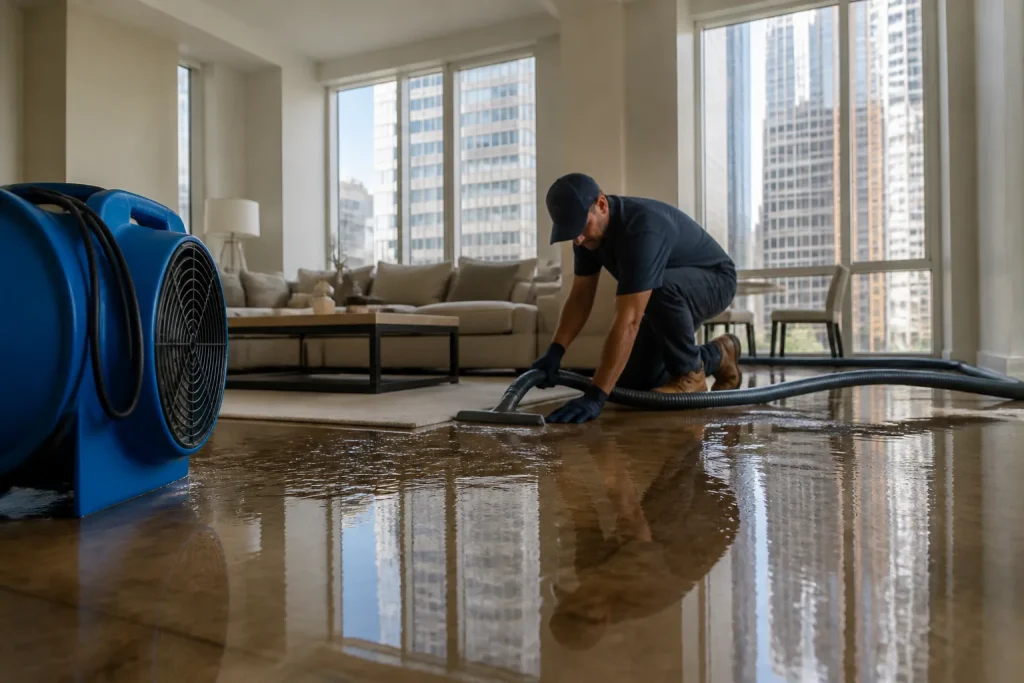
- Emergency extraction and containment: $1,800-$4,500. Truck-mounted extraction, containment barriers, and the first moisture map. In a high-rise, this also covers protecting common areas from water tracking through the lobby.
- Drying equipment days: $250-$600 per day. Commercial dehumidifiers and air movers pull 30-50 pints daily. Pre-war plaster often needs 5-7 days; gypcrete in a tower can run 3-5. That’s a $1,250-$4,200 line item before labor.
- Demolition and disposal: $1,500-$6,000. In a Financial District building, disposal isn’t a dumpster in the driveway. It’s bagged debris through a freight elevator on a schedule, often with a building porter watching the clock. Some buildings charge $200-$500 per disposal event.
- Mold testing and treatment: $400-$2,500. If water sat more than 48 hours, your carrier may require testing. Post-remediation verification (PRV) is another $400-$900. We’re certified to handle this alongside the water loss, which keeps it one invoice instead of three. See Mold Remediation in Financial District for what full-scale remediation looks like.
- Rebuild: $35-$90 per square foot. This is the wide range. Replacing pre-war plaster and matching original hardwood costs toward the top. Floating LVP in a modern tower costs toward the bottom. The financial district has a lot of both.
When we give a Financial District homeowner a number, it breaks down like this on paper. No mystery line items. No “miscellaneous fees.” A written scope before work starts, every time.
Hidden Costs Unique to Financial District High-Rises
This is where national averages become fiction. A suburban house has a driveway, a breaker panel in the garage, and a building code office that returns calls. A Financial District unit has none of that. Here’s what actually shows up on job invoices in this neighborhood:
- Freight elevator access fees: $300-$700 per day, and some buildings require a superintendent escort at $50-$75 per hour. A 5-day drying job can add $2,500-$4,000 in access costs alone before a single piece of equipment is plugged in.
- After-hours building staff overtime: If a pipe breaks at 2 a.m., the front desk calls the super. Some buildings pass that overtime to the unit owner. Expect $150-$400 for the call-out, depending on the management company.
- Asbestos testing (buildings constructed before 1980): Mandatory before demo in most pre-war Financial District buildings. Testing runs $800-$1,500 per area, and if asbestos is present, abatement doubles or triples the demo line. Any legitimate restoration contractor will require this before cutting into walls or flooring.
- DOB permit timelines and filing costs: Structural rebuild work in a high-rise often requires a Department of Buildings filing. Fees run $500-$2,500, and the timeline can add 2-6 weeks between drying and rebuild. A contractor who promises to skip permits isn’t doing you a favor; they’re creating a liability that hits you at resale.
- Substrate matching: Replacing a section of pre-war oak flooring means sourcing lumber with similar age, grain, and milling. That’s a specialty supplier, not a big-box store. Add $4-$8 per square foot over standard replacement flooring.
A $3,000 “national average” water loss in a Financial District pre-war co-op is a $14,000 job by the time freight elevator fees, asbestos testing, and a real drying plan hit the invoice. That gap is real, and it’s why we price every job from the building’s actual conditions, never a spreadsheet average.
Which Costs Your Insurance Carrier Covers (and Which They Fight)
Most Financial District homeowners have a condo or co-op policy that covers water damage from sudden, accidental discharge. That means a supply line break, an overflowing tub, a failed water heater connection. Not seepage through a foundation wall over months, and not mold that grew because a leak was ignored. Here’s how the line items shake out with your carrier:
- Routinely approved: Emergency extraction, drying equipment, basic demo of wet materials, standard rebuild of affected areas, mold treatment directly tied to the covered water event.
- Frequently disputed: Freight elevator fees (carriers call them “building access charges” and sometimes cap them at suburban dumpster rates), asbestos testing (they want it tied to the specific water-damaged area only), custom finish matching (carriers pay for “like kind and quality,” not “identical to your 1928 original”), and any drying beyond 72 hours without documented daily readings.
- How to push back: Document everything. Daily moisture readings, photos with timestamps, written rationale for each drying day beyond three. When we handle a Financial District water loss, our moisture log goes to the carrier directly. That log is the difference between a supplement approved in a week and one fought for two months. We bill the carrier directly, so you’re not fronting money and waiting for reimbursement while the damage gets worse.
One more thing: if your building’s master policy covers the loss, your own carrier may coordinate with the building’s carrier. In co-ops especially, the line between “unit” and “building” damage gets blurry. We’ve handled enough Financial District co-op losses to know which line items belong on which claim, and we document the job accordingly. That’s not something a national franchise learns in training; it’s something you learn by doing hundreds of jobs in the same neighborhood.
Why Split-Contractor Models Cost More in the End
You’ll hear it from some companies: “We do extraction and drying. For rebuild, we’ll refer you to a great contractor.” That sounds like division of labor. In practice, it’s division of responsibility, and you’re the one holding the pieces.
Here’s what actually happens. The extraction company says the space is dry and walks away with their check. The rebuild contractor arrives, pulls back trim, and finds moisture the first company missed. Now you’re on the phone with two companies, two invoices, and an adjuster asking why there’s a second supplement. The rebuild contractor blames the extraction crew. The extraction crew says the rebuild contractor is looking for change orders. Nobody’s wrong, nobody’s accountable, and you’re paying for the gap.
We walked into a Financial District loft last year where exactly this had happened. The first company declared the kitchen dry after three days. The rebuild contractor pulled the baseboard and found the subfloor at 19% moisture. The whole floor had to come out. The homeowner paid for two dry-outs, two demos, and a rebuild that was 40% higher than if one crew had owned the job from day one.
When Floodline Restoration Co. home handles a water loss, the same certified technicians who ran the first extraction read the daily moisture levels, hand the log to the homeowner and the carrier, and rebuild what needs rebuilding. No mid-job handoff. No inherited crew. One phone number, one guarantee, one company standing behind the whole job.
The 90-Day Warranty Math: Why Low Bidders Can’t Offer It
Most restoration companies in the Financial District offer a 30-day workmanship warranty, if they offer one at all. Some offer nothing in writing. Here’s why that matters in dollars.
A proper 90-day guarantee on water damage restoration means the company is willing to come back, reopen walls, re-dry, and re-rebuild at their own cost if something fails. The actuarial reality: roughly 12-15% of water damage jobs with incomplete drying or rushed rebuilds develop callback issues within 90 days. A company running thin margins on the lowest bid cannot absorb a 12% callback rate. They’ll drag their feet, blame the carrier, blame the building, or just stop answering the phone.
A 90-day guarantee isn’t a marketing line. It’s a structural commitment that costs real money to back. It means the company priced the job correctly, dried the space to the actual standard instead of “good enough,” and plans to be in the Financial District in thirty years. We’re proud to serve local communities and have been doing exactly that since 2010. Our 90-Day Done Right Promise, what we call the Keystone Standard, is in writing on every job. If it’s not done right, we make it right. No paperwork battles, no arguing. That’s the whole point.
This is the filter that explains most cost differences in the Financial District market. The low bidder isn’t cheaper. They’re just not pricing the warranty, the callback risk, or the building access costs that will show up on your supplement anyway. The square deal is the honest number up front, backed in writing.
What Quality Equipment Actually Changes About the Price
Equipment quality shows up in drying time, and drying time is the single biggest driver of total cost. A high-capacity Dri-Eaz dehumidifier can pull 50+ pints a day. A Phoenix unit runs cooler and quieter, which matters in a Financial District apartment where you’re sleeping in the next room. XPOWER air movers and B-Air units get placed based on the moisture map, not scattered around the wet room. Injectidry systems handle water trapped in wall cavities and under cabinets without tearing everything out. The right equipment on day one can cut drying time by 2-3 days. At $300-$500 a day in equipment, access fees, and monitoring, that’s a real savings, and it means you’re back in your home faster.
The equipment line in your estimate isn’t padding. It’s the difference between a 4-day dry-out that holds and a 7-day dry-out that delaminates your engineered flooring. Ask any contractor what brands they run. If they won’t tell you, that’s an answer too.
The Bottom Line
Water damage restoration in the Financial District in 2026 costs $9,000-$28,000 for a typical single-unit loss, before any surprises. The surprises here aren’t acts of God. They’re freight elevator fees, asbestos testing rules, building staff overtime, and a contractor who priced the job like a suburban ranch house. Get a written scope with daily moisture logs. Ask about equipment brands. Ask about the warranty in writing. And if the number sounds too good to be true against every other bid, it is.
If you’re in the Financial District and dealing with water damage right now, Floodline Restoration Co. offers free estimates with no obligation. We bill your carrier directly, document every drying day, and stand behind the job for 90 days in writing. Call (518) 663-6491 and a live person answers, any hour, any day.
Frequently Asked Questions
Most Financial District water losses run $9,000-$28,000 for a single-unit event, depending on building type, water category, and how quickly extraction begins. A pre-war co-op on the higher end, a modern tower unit on the lower end. Call (518) 663-6491 for a free estimate specific to your building.
Yes, if the damage came from sudden and accidental discharge like a pipe break, supply line failure, or overflowing fixture. Carriers routinely dispute freight elevator fees, asbestos testing, and custom finish matching. Photo documentation and daily moisture logs are your best leverage. We bill carriers directly and handle the documentation for you.
That depends on the company. Floodline Restoration Co. has a live dispatcher answering 24/7, every day of the year. A certified crew can be on site the same visit, extraction running, with the moisture map started. In a high-rise, every hour of delay adds drying days and rebuild cost.
If water sat more than 48 hours, most carriers and most building management offices will require it. Mold testing runs $400-$900, plus post-remediation verification. We handle water damage and mold remediation under one roof, so you’re not coordinating two companies. See Mold Remediation in Financial District for more.
Fire and smoke restoration pricing is its own animal, especially in high-rise buildings with positive-pressure HVAC systems that spread soot through common risers. See Fire & Smoke Damage Restoration in Financial District for a full breakdown.
Written by Curt Bowman, Owner at Floodline Restoration Co., serving Financial District since 2010.
Need Damage Restoration Help?
Call Floodline Restoration Co. - licensed & insured, here with fast after-hours help in Financial District.
(518) 663-6491