
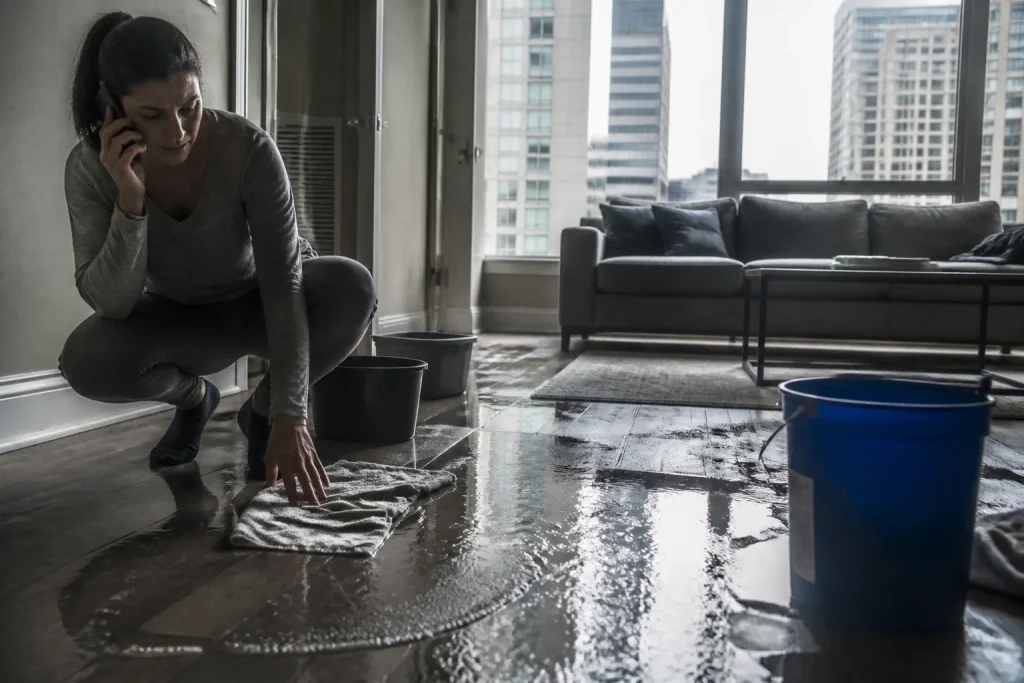
Emergency Water Damage Restoration Near Me: What Financial District Homeowners Should Do First
If you’re searching “emergency water damage restoration near me” from a Financial District apartment or condo, stop searching and start the sequence. The first 90 minutes determine whether you’re looking at a $4,000 dry-out or a $40,000 mold remediation plus rebuild. Here’s exactly what to do first: shut off the water source if you can safely reach it, kill power to affected rooms at the breaker, call a restoration company that answers with a live dispatcher at (518) 663-6491, and document everything with your phone before you touch a single wet item. If you’d rather not navigate this alone, call us at (518) 663-6491 now and a certified crew from Floodline Restoration Co. will be on the way while you’re still reading.
Forty-eight hours is how long you have before Category 1 clean water becomes a secondary contamination problem in a sealed high-rise unit. Most homeowners spend the first two hours on hold, photographing damage for social media, or waiting for a building super who can’t authorize remediation anyway. Here’s what Financial District residents need to know before the water line stops rising.
The First 90 Minutes: A Sequence That Matters More Than You Think
Water damage in a Financial District high-rise follows a different physics than a flooded basement in a single-family home. There’s no sump pump, no natural drainage, and every gallon that leaves your unit passes through someone else’s ceiling before it reaches the street. The sequence you follow in the first hour and a half determines how much of your life gets disrupted.
Step 1: Stop the source (if it’s yours to stop)
Find the shutoff valve for the fixture that failed. In most Financial District co-ops and condos built after 1980, each unit has its own shutoff behind an access panel near the kitchen or laundry line. If the water is coming from a common area pipe in the wall or ceiling, do not try to access it yourself. That’s the building’s responsibility, and opening a wall chasing a pipe will muddy the insurance picture. Call the super. If they don’t answer, call the management office emergency line. Document every call you make: time, name, what they said. Adjusters will ask for this later.
Step 2: Kill electricity to the affected rooms
Water and electricity in a confined apartment are a serious hazard. Flip the breakers for the affected areas. Do not stand in water while touching your electrical panel. If the panel is wet or you can’t reach it without standing in water, stay out and tell the restoration crew when they arrive. This is worth repeating: do not run box fans from outlets in wet rooms. A $20 fan is not worth an electrical fire on top of a flood.
Step 3: Call a restoration company that answers with a person
This is where “near me” fails most homeowners. The closest restoration company might be a call center that takes a message for the morning shift. What you need at 2 a.m. is a live dispatcher who can authorize a crew to mobilize right then. Floodline Restoration Co. has answered the phone with a live person every day since 2010. A certified crew with Dri-Eaz and Phoenix extraction equipment reaches Financial District jobs the same visit, and extraction is running before we leave. That’s the difference between drying a unit in three days and ripping out drywall in three weeks.
Step 4: Document before you move anything
Take photos and video of every affected area before you touch a single item. Walk the perimeter of each room. Open cabinets. Photograph the water line on drywall, water pooled on flooring, and any visible source like a burst supply line. What adjusters actually look for: wide shots that establish the full scope, then close-ups of the water line height, and a time-stamped video walkthrough. What’s useless: 40 photos of the same puddle from slightly different angles. If you have a moisture meter or know a neighbor who does, later readings can help, but don’t delay mitigation waiting for one. Your phone photos are sufficient to start.
Why Your Co-op Board and the Building’s COI Requirement Come Before Everything
Here’s a reality most restoration companies won’t tell you: in the Financial District, a contractor cannot legally enter most buildings without a Certificate of Insurance on file with the management company. This is not a suggestion. Buildings in the district routinely require contractors to carry general liability policies of $1 million or more, workers’ compensation coverage, and specific naming of the condo or co-op entity as an additional insured. If the restoration company you call can’t produce a COI that satisfies your board within the hour, you’re not getting dried out tonight.
We’ve seen homeowners lose entire evenings to this. They call a restoration company, the crew shows up, the doorman turns them away because the COI isn’t on file, and now it’s 11 p.m. and the water has been sitting for six hours. Floodline Restoration Co. handles COI coordination before the crew arrives. We know the management companies in Financial District buildings, we carry the coverage they require, and our office sends the paperwork while the truck is rolling. That’s not a convenience. That’s the difference between extraction today and extraction tomorrow.
The Property Line Nobody Explains: Common Area vs. Unit Owner Responsibility
This is where Financial District homeowners get surprised by their own insurance policies. The line between building responsibility and unit owner responsibility shifts depending on where the water came from. If a common area pipe failed inside a wall or ceiling, the building’s master policy typically covers the common area repair and sometimes the water damage to your unit’s structure. If the failure happened at or beyond your unit’s shutoff valve, a failed washing machine supply line or a cracked toilet tank, then it’s your HO-6 policy that pays.
That line determines whose carrier takes the loss, and it also determines what get repaired under which claim. We deal directly with adjusters and carriers on Financial District jobs every week. We bill the carrier directly, so our customer never plays middleman between Floodline and the insurance company. If the building’s carrier is involved, we still handle the scope, documentation, and repair, and we keep both adjusters informed. What we don’t do is let a homeowner sit on hold with a carrier while standing water spreads through wood floors. We handle the claim communication.
What a Live Phone Answer at 2 A.M. Actually Gets You
Any restoration company can print “24/7 emergency service” on a magnet. What that phrase means operationally varies wildly. A call center that takes a message and marks it for the morning shift is not emergency service. A live dispatcher who knows the Financial District, knows which buildings require which COI paperwork, and can put a certified crew on the truck right then, that’s an emergency response.
Floodline Restoration Co. has run a dispatch board, not a sales desk, since 2010 when Curt Bowman founded the company. The person who answers the phone at 2 a.m. is not reading from a script. They’re checking the board, confirming which certified technician is on call, and arranging for the truck to roll. The same crew that extracts the water on day one performs the daily moisture readings, logs the drying progress, and hands the moisture log to the homeowner and the carrier. One crew, one company, from the first pump to the final coat of paint. That’s what we mean by done right and backed in writing.
How to Document the Loss So Your Claim Doesn’t Get Denied
Adjusters are not your enemy, but they are not your advocate either. They’re measuring the loss against the policy language, and the quality of your documentation determines how much they approve. Here’s what actually matters in the first hour:
- Establish the water line height immediately: photograph a tape measure held against the wall at the highest visible water mark. This tells the adjuster how much drywall comes out.
- Open every cabinet and closet in affected rooms: water travels horizontally inside wall cavities. Show the inside of lower cabinets that might not look wet but are. Darkened wood or swelling MDF is evidence.
- Photograph the source if you can safely reach it: a burst supply line under a sink, a failed washing machine hose, a ceiling bubbling from the unit above.
- Do not move furniture, pull up carpet, or remove wet items until the restoration crew documents the scene: anything you move changes the evidence. Your insurance policy requires you to mitigate further damage, but mitigation starts with extraction, not with dragging your wet couch out to the hallway and restacking it in a dry corner.
- Note the time on each sequence of photos: a phone timestamp with photos taken before and after you called the super matters when the adjuster asks why mitigation wasn’t started sooner.
We also photograph everything when we arrive. Photo-documented assessments are part of our standard scope on every Financial District water job. Those photos go to the carrier with daily moisture readings, so the claim file stays consistent from first response to final repair.
What Actually Happens During Extraction and Drying in a High-Rise Unit
If you’ve never seen professional-grade water extraction in a Financial District apartment, the process is quieter and faster than most people expect. We bring truck-mounted or portable extraction units depending on building access. Extraction removes standing water first. Then we set drying equipment, commercial dehumidifiers and high-volume air movers from brands like Dri-Eaz, Phoenix, and XPOWER, positioned to create airflow across every wet surface. In confined high-rise units, we often use Injectidry systems for floors and wall cavities where conventional drying can’t reach.
Moisture mapping comes next. We take readings from every affected material, log them against the dry standard for that material type, and return daily until every reading is within range. You get a copy of the moisture log. So does your carrier. There’s no mystery about whether the job is done. The numbers either hit the dry standard or they don’t. If they don’t, we keep drying until they do. That’s the 90-Day Done Right Promise, the Keystone Standard, in writing with no arguing and no paperwork battles.
Most jobs are completed in a single visit for extraction and equipment placement. Daily monitoring visits follow, but the heavy work, the extraction and initial equipment set-up, happens the same visit the crew arrives. We work around your schedule for the monitoring visits, and a uniformed, background-checked technician is on every job, trained to IICRC, RIA, and IFA standards.
One thing we see regularly in Financial District buildings: a small leak that ran down inside a wall for weeks before anyone noticed. Last month we pulled affected drywall from a unit near South Street where a pinhole in a supply line had been feeding the wall cavity for somewhere around three weeks. The homeowner only caught it when the baseboard started swelling. The unit above had no idea. By the time we got there, the moisture readings behind the sheetrock were off the meter, and we were cutting out wall sections to stop the spread. That’s not an uncommon story in older high-rises.
When to Call a Pro
If you can see standing water, you need professional extraction. If you can smell a damp, earthy odor even without visible water, you need a moisture meter on your walls. If the water came from a sewage line, do not attempt any cleanup yourself. Sewage cleanup is a biohazard category that requires proper protective equipment and disposal protocols. If you’re not sure, call us at (518) 663-6491 and describe what you’re seeing. We’ll tell you over the phone whether you can wait or whether a crew should roll now. No charge for the conversation.
Related services in Financial District: Water Damage Restoration in Financial District covers the full extraction and drying process, and if water has been sitting for more than 48 hours, Mold Remediation in Financial District explains what happens next. If the water came from a fire suppression system or a kitchen fire, our Fire & Smoke Damage Restoration in Financial District page walks through that process. And for an overview of how Floodline Restoration Co. keeps every job whole from first response to final rebuild, start there.
The Bottom Line
Searching “emergency water damage restoration near me” in the Financial District is useful only if the company behind that search result can actually enter your building, answer your call with a live person, and stay on the job from extraction through drying and rebuild. The first 90 minutes are the whole game. Shut off what you can safely shut off, kill power to wet areas, photograph everything before you move it, and call a restoration company that runs a dispatch board, not a call center queue. If you’re in Financial District and need help now, Floodline Restoration Co. offers free estimates and direct insurance billing. Call (518) 663-6491 and a live dispatcher will get a certified crew moving today.
Frequently Asked Questions
If you call Floodline Restoration Co. at (518) 663-6491, a live dispatcher answers and can typically have a certified crew on the road to your Financial District building within the hour. The answer varies by time of day and how many emergency jobs we’re already running, but the same visit includes extraction and initial equipment placement. Call us and we’ll give you an honest arrival window.
Most HO-6 condo and co-op policies cover water damage to your unit from a sudden, accidental event, like a burst supply line or a failed appliance. Coverage for slow leaks over weeks or months is often excluded or limited. Your claim’s success depends on early documentation and professional mitigation. We photograph everything before we start work and bill your carrier directly.
If the water soaked into drywall, flooring, or wall cavities, surface cleaning won’t dry what you can’t see. Hidden moisture becomes mold within 48 hours, and in a sealed high-rise unit with shared wall cavities, that mold spreads. Professional drying with moisture mapping and daily readings is the only way to confirm the structure is actually dry. A cleaning alone leaves moisture behind.
Floodline Restoration Co. deals directly with your insurance adjuster. We provide photo documentation, daily moisture logs, and a written scope we agree on before work starts. You never play messenger between us and the carrier. We bill directly when the policy allows, and the 90-Day Done Right Promise covers the result in writing.
Written by Curt Bowman, Owner at Floodline Restoration Co., serving Financial District since 2010.
Need Damage Restoration Help?
Call Floodline Restoration Co. - licensed & insured, here with fast after-hours help in Financial District.
(518) 663-6491