
B-Air Water Damage Restoration in Financial District: A Homeowner’s Guide
A single misplaced B-Air unit in a concrete-core building can drive moisture laterally into a neighboring unit’s wall cavity. That problem doesn’t show up on a surface reading for 10 to 14 days, and when it does, it usually shows up as someone else’s mold claim. In Financial District high-rises, drying equipment is only as effective as the moisture mapping done before it’s placed. If you’re dealing with water damage right now and want a straight answer on whether your drying plan is sound, call (518) 663-6491.
Why Financial District Buildings Dry Differently
Most drying advice online assumes a wood-frame house with a crawl space. That advice falls apart the moment you’re standing in a pre-war co-op on Maiden Lane or a glass-tower condo on West Street. Financial District buildings are steel and concrete. Concrete holds water. It wicks moisture slowly, releases it slowly, and hides it in places a surface meter never sees. Wood framing dries outward. Concrete drives moisture inward and sideways.
We’ve pulled baseboards off in Financial District units where the drywall face read 8% moisture content, but the bottom plate behind it read 34%. That’s the difference between a room that looks dry and a room that actually is dry. In a high-rise, the drywall anchors into concrete or metal studs. Water travels along those anchors, behind the vapor barrier, and into the wall cavity. If you only dry the surface, you leave the cavity wet. A month later, the mold bloom starts.
This is why Water Damage Restoration in Financial District requires a different playbook than the one used in Queens or Nassau County. The building envelope is different. The airflow is different, because most units share return air with neighbors through common shafts. And the liability is different, because your drying problem can become your neighbor’s mold problem without anyone touching a pipe.
What B-Air Equipment Actually Does (and Doesn’t Do)
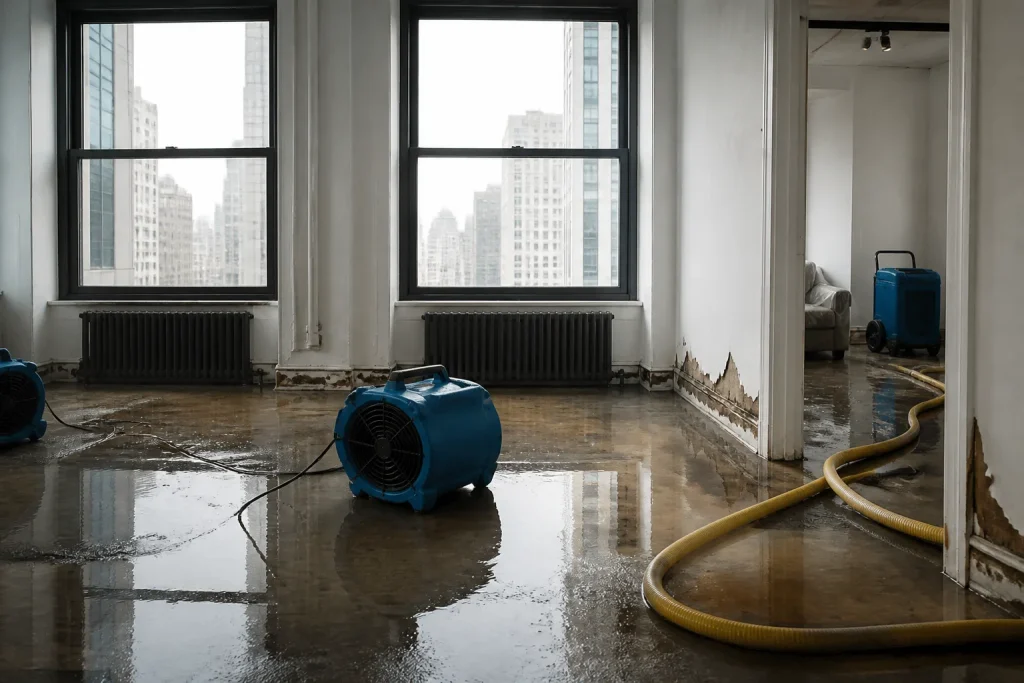
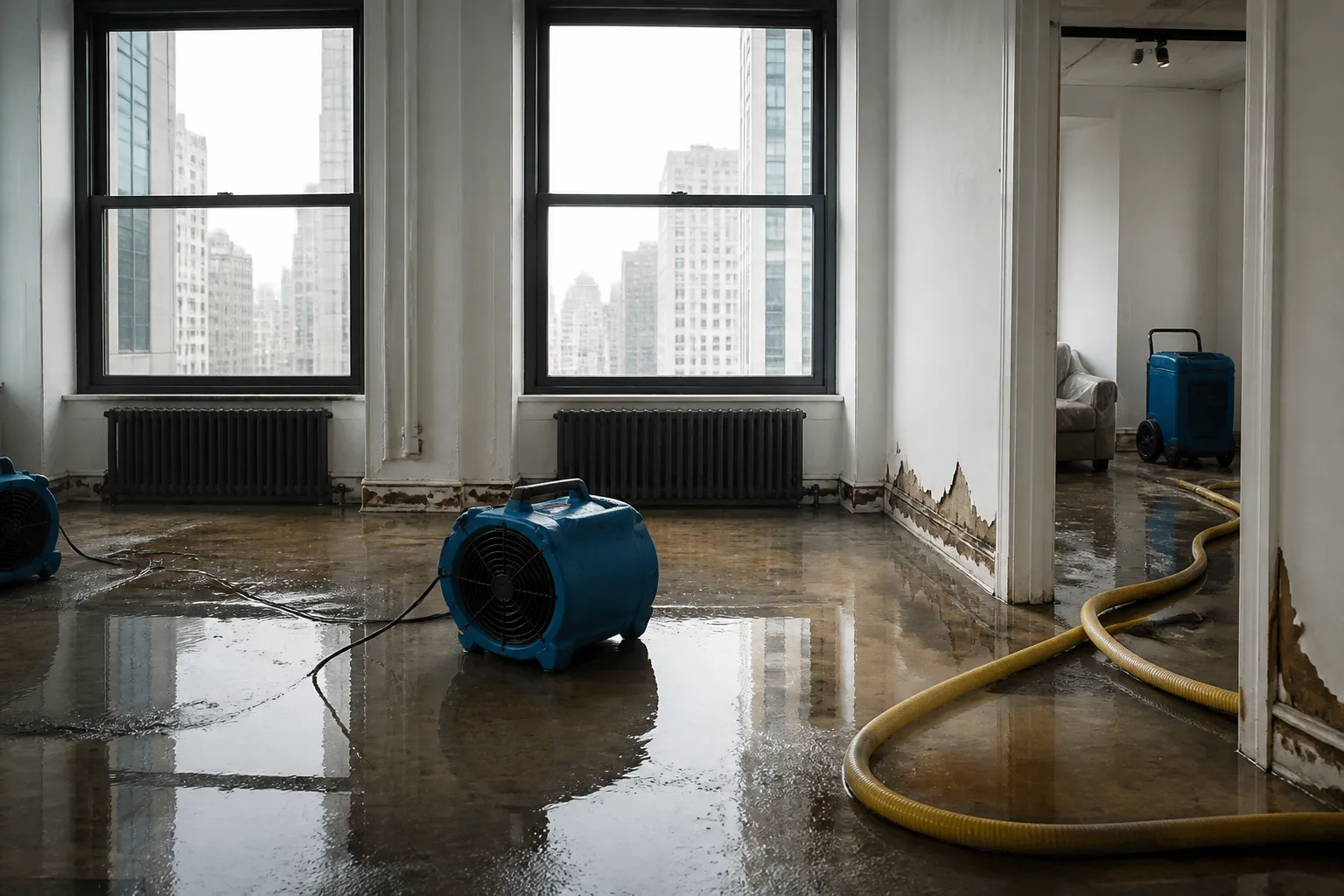
B-Air makes professional-grade air movers, dehumidifiers, and negative air machines. Their equipment is on par with Dri-Eaz and Phoenix units for moving air and pulling moisture. We run B-Air equipment on jobs where the layout calls for compact, high-velocity units that fit under cabinets or into tight mechanical closets. The equipment is not the problem. The placement is the problem.
An air mover does one thing: it moves air across a surface. That works when the moisture is on the surface. It works less when the moisture is in a wall cavity, behind a concrete column, or trapped under a floating floor. In a Financial District high-rise, the water that matters is almost never on the surface. It traveled down through the subfloor, wicked into the drywall, and followed the steel studs. An air mover pointed at the drywall will dry the drywall. It will not dry what’s behind the drywall.
Before any equipment gets placed, a thermal imaging pass should show exactly where the water went. Thermal cameras read temperature differentials. Wet materials are cooler than dry materials. That difference creates a map. Without that map, air mover placement is a guess. With that map, placement follows the water. It’s the difference between drying a room and drying a building assembly.
Surface Drying vs. Cavity Drying in Financial District High-Rises
Here’s the question that separates a real restoration crew from a rental company with a truck: are they drying the surface or the cavity?
Surface drying is what most crews do. They set air movers, point them at visible water, and take moisture readings from the floor and wall face. The numbers drop. The equipment comes out. The job looks done. Then three weeks later, the homeowner smells something. The baseboard swells. The neighbor downstairs reports a stain on their ceiling.
Cavity drying is different. It requires understanding where water traveled inside the building assembly. In a Financial District co-op or condo, water from a burst pipe on the 14th floor can travel down the riser chase and pool behind the drywall on the 12th floor. It can run along conduit and drip into a light fixture. Surface drying never touches that water because surface drying never looks for it.
- Surface drying: addresses visible water, reads the face of materials, and typically finishes in 3 to 5 days.
- Cavity drying: addresses hidden water, uses thermal imaging and deep-probe meters, and typically runs 5 to 10 days depending on concrete saturation.
- The difference: one dries what you can see. The other dries what the water actually touched.
In our experience, cavity drying in Financial District buildings takes longer, costs more, and prevents problems that would otherwise surface six weeks after the crew has left. The cheaper bid is usually surface drying. The customer just doesn’t know that’s what they’re buying.
How Building Management and Co-op Rules Change the Drying Plan
If you live in a co-op or condo in Financial District, you don’t control the whole drying equation. Building management does. The riser chases, the common hallways, the mechanical rooms, the electrical closets, all of it belongs to the building. A restoration crew can’t just run an extension cord down the hallway or place a dehumidifier in the stairwell. Access requires coordination with management, and management has their own priorities.
We’ve worked in buildings where management required a certificate of insurance before any equipment came through the lobby. That’s standard now. Some buildings restrict work hours. Some require a building engineer on site while equipment runs. Some won’t allow equipment in shared spaces at all, which means the drying plan has to work entirely inside the unit. That last constraint is where crews make mistakes. They set up as if they have unlimited space, and the plan falls apart.
The shared-wall liability is the part most homeowners never think about until it’s a problem. If your drying is too aggressive or too passive, the water moves. Aggressive drying without moisture mapping can push vapor into a neighbor’s wall cavity. Passive drying can leave moisture sitting so long that mold grows on the shared drywall. Either way, you’re now dealing with two units, two insurance claims, and a building manager who wants answers. Written documentation of the drying plan, equipment placement, and daily readings protects everyone involved.
What a Legitimate Drying Log Should Show
Any crew that can’t produce a drying log is guessing. That’s not a slam. It’s just a fact. A drying log is the paper trail that proves the job was done to a standard, not to a schedule. Here’s what a legitimate log shows day by day:
- Day 1: moisture map from thermal imaging, initial readings from every affected surface, equipment placement plan, list of affected materials.
- Day 2: re-readings from the same points, equipment adjustments documented, any newly discovered moisture noted.
- Day 3 through day 5: steady decline in readings on wood and drywall, with concrete readings tracked separately because concrete dries slower.
- Day 6 through day 8 (or later): cavity probes confirming the inside of the wall is dry, not just the face.
- Final day: all readings below the dry standard, a list of what got dried and what got removed, and a written statement that the job is complete.
The dry standard matters. For wood in most environments, it’s between 8% and 12% moisture content. For drywall, below 1% on a moisture meter in most cases. Concrete in Financial District buildings can read higher for months without being a problem, as long as it’s trending down and the adjacent materials are dry. A good log shows the trend, not just the number.
If a crew can’t hand you a log with daily readings, dated entries, and specific moisture numbers, they’re not documenting anything. They’re hoping. And hope is not a drying method.
The One Question to Ask Before Any Equipment Gets Placed
Before a single air mover goes down, ask this: has a thermal imaging pass already confirmed where the water actually traveled?
If the answer is no, stop the job. Thermal imaging is not a luxury. It’s the map that tells the crew where to place equipment, where to open walls, and where to leave things alone. Without it, the crew is guessing. They’ll guess wrong in a Financial District high-rise more often than not, because water in concrete buildings travels in ways that defy intuition. It runs along rebar. It follows pipe chases. It pools in fire stops. None of that is visible on the surface.
The same goes for invasive metering. Surface meters read the face. Deep-probe meters read the cavity. If the crew only has a surface meter, they’re only getting half the story. And the half they’re missing is where the problem lives.
We don’t place equipment until the map is built. That’s true on every job, from a slab leak in a ground-floor retail space to a riser leak on the 30th floor. The map tells us where the water went. The water tells us where the equipment goes. The equipment tells us what the moisture log will say. Everything else is noise.
When to Call a Pro
Water damage in a Financial District high-rise is not a DIY project. If the water came through the ceiling, involved a riser pipe, or sat for more than a few hours, the damage is already in the cavity. You can’t fan that out. If you notice staining on baseboards, a musty smell that comes and goes, or paint bubbling near the floor line, the water is behind the finish, not on it. That’s the time to call.
Related services in Financial District: Mold Remediation in Financial District, Fire & Smoke Damage Restoration in Financial District, and Floodline Restoration Co. home for full-cycle restoration information.
The Bottom Line
B-Air equipment is good equipment. It moves air and pulls moisture as well as anything on the market. But an air mover is only as smart as the moisture map that guides it. In Financial District high-rises, where concrete hides water and shared walls turn mistakes into neighbor disputes, the map is the whole job. Surface drying is cheap until it isn’t. Cavity drying, documented with daily readings, is the only thing that actually finishes the job.
If you’re in Financial District and need help, Floodline Restoration Co. offers free estimates. Call (518) 663-6491. A live person answers, we’ll walk you through what we’d check, and we’ll give you a straight answer. No pressure. No guessing.
Frequently Asked Questions
Most cavity drying jobs in Financial District buildings take 5 to 10 days, depending on how much concrete absorbed the water and how accessible the affected cavities are. Surface drying runs faster, often 3 to 5 days, but it may not dry what’s behind the drywall. Call (518) 663-6491 for a specific timeline based on your building’s construction.
Most Financial District co-ops and condos allow restoration equipment inside individual units, but they often require a certificate of insurance, restricted work hours, or a building engineer on site for equipment in shared spaces. Your restoration crew should coordinate directly with management so you don’t have to. That coordination is part of the job.
Ask for the drying log. It should show daily moisture readings from the same points, thermal imaging results from day one, and cavity probe readings from before the equipment was removed. If the crew can’t produce a dated log with specific numbers, the job wasn’t documented to a standard. A legitimate company will hand you the log without being asked.
Most homeowners policies cover water damage restoration including drying equipment, as long as the cause is sudden and accidental. Floodline Restoration Co. bills the carrier directly and documents everything with photos and daily readings, so you’re not playing messenger between the adjuster and the crew. Call (518) 663-6491 and we’ll help you sort out coverage.
Written by Curt Bowman, Owner at Floodline Restoration Co., serving Financial District since 2010.
Need Damage Restoration Help?
Call Floodline Restoration Co. - licensed & insured, here with fast after-hours help in Financial District.
(518) 663-6491